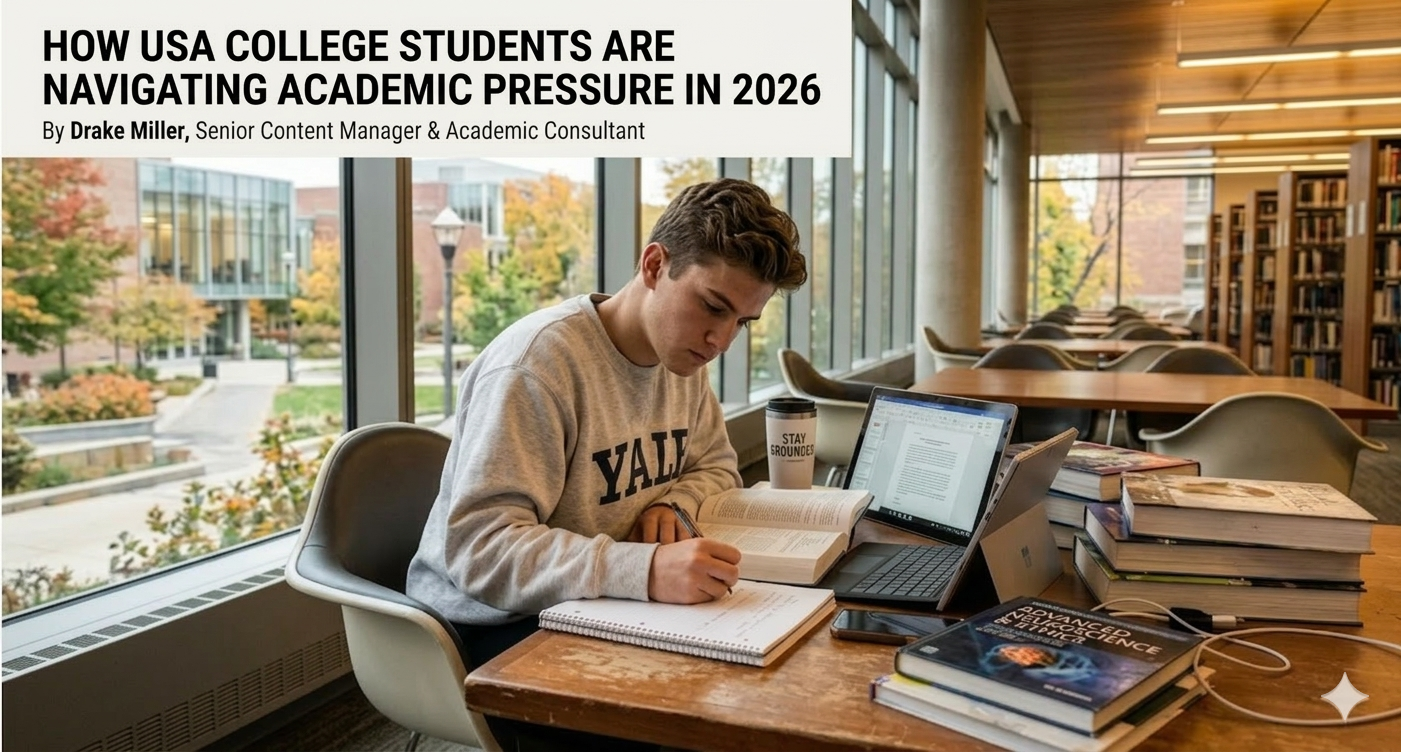
How USA College Students Are Navigating Academic Pressure in 2026
By Drake Miller, Senior Content Manager & Academic Consultant
The American higher education landscape in 2026 looks vastly different from the post-pandemic recovery years. While the core mission of colleges—education and preparation for the future—remains steadfast, the pressures facing students have evolved into a complex tapestry of technological shifts, economic uncertainties, and a radical new focus on holistic well-being. Today’s high school seniors and college undergraduates are navigating a world where the stakes are higher than ever, and the tools they use to cope are equally advanced.
From the rise of “Hyper-Personalized Learning” to the normalization of digital detoxes, the 2026 student experience is defined by a blend of high-tech efficiency and deep-seated human resilience.
The 2026 Academic Climate: Why the Pressure is Peaking
The year 2026 has redefined the academic landscape, placing immense pressure on students to balance traditional learning with rapid technological shifts. In this high-velocity environment, the “four-year degree” path is under more scrutiny than ever. With the cost of living in major college hubs like Boston, New York, and San Francisco reaching record highs, students feel a relentless need to justify every cent of their tuition. It’s no longer enough to just “graduate”; students feel pressured to build a personal brand, secure internships by their sophomore year, and master AI-integrated workflows before they even hit the job market.
Furthermore, the “Always-On” culture, fueled by ubiquitous 6G connectivity, means that the boundary between campus life and professional preparation has virtually disappeared. High schoolers transitioning into this environment are often overwhelmed by the sheer speed of academic delivery. This is particularly true for students tackling complex technical subjects; for instance, those struggling with simulation and coding often seek specialized MATLAB assignment helpto keep pace with their curriculum. According to recent 2026 mental health surveys, nearly 83% of US teenagers cite “academic performance” as their primary stressor, a figure that has held steady despite increased institutional support.
1. AI-Powered Productivity: Working Smarter, Not Harder
By 2026, Artificial Intelligence has moved from being a “controversial tool” to a standard academic companion. Students are no longer just using AI to generate ideas; they are using it to manage their cognitive load.
Custom GPT Tutors and Specialized LLMs
Many students now utilize specialized AI models trained on specific curriculum sets to explain complex concepts in real-time. This reduces the “bottleneck” frustration of getting stuck on a single math problem or a dense piece of literature for hours. These tools act as 24/7 teaching assistants, providing personalized feedback that mimics a 1-on-1 tutoring session.
Strategic Academic Support & Delegation
To manage the sheer volume of assignments, students are increasingly turning to professional support systems. Whether it’s seeking expert guidance for a complex dissertation or finding specialized assignment help at Myassignmenthelp.com for secondary subjects, students are prioritizing their core majors. This “resource management” approach allows them to outsource technical formatting or preliminary research tasks, preserving their mental energy for high-level critical thinking and creative synthesis.
Predictive Analytics for Burnout
Modern Learning Management Systems (LMS) now predict when a student is likely to burn out based on their submission patterns and digital engagement levels, prompting them to take proactive breaks before a crisis occurs.
2. The Shift Toward “Skill-Based” Validation
The pressure of “getting an A” is being rivaled by the pressure to “get a skill.” In 2026, a 4.0 GPA is often seen as secondary to a portfolio of verified, real-world projects.
Students are dealing with this by diversifying their learning. Many high school graduates are opting for “micro-credentials” alongside their degrees. This “stackable” education model allows students to feel a sense of progress even when a specific semester feels overwhelming. By achieving small wins through certifications in data science, digital ethics, or creative coding, the crushing weight of the final degree becomes a series of manageable milestones.
3. Radical Mental Health Prioritization
In 2026, mental health is no longer a footnote in the student handbook; it is the headline. The “hustle culture” of the early 2020s has been met with a powerful counter-movement: The Rest Revolution.
- No-Questions-Asked Wellness Days: Most US universities have now codified mental health days into their attendance policies. Students are learning to advocate for their needs, recognizing that a 24-hour break can prevent a two-week burnout.
- Virtual Reality (VR) Therapy: On-campus counseling centers have evolved. Students now have access to VR meditation pods that transport them from a cramped dorm room to a serene Pacific beach, providing immediate physiological relief from academic anxiety.
- Peer Support Networks: Decentralized, student-led support groups organized on platforms like Discord have replaced the more formal, intimidating counseling sessions of the past.
4. Living and Learning: The Impact of Hybrid Housing
For those following the trends at Hearth States, the physical environment of the 2026 student is a key factor in stress management. The “Great Pivot” to hybrid learning has been perfected, leading to a redesign of student living.
- Dorms as Co-working Spaces: Traditional dorms are being replaced by professional-grade co-working environments. This helps students separate “home” from “work,” a boundary that is crucial for managing long-term academic stress.
- Asynchronous Freedom: By choosing when to consume lectures, students can align their study habits with their natural circadian rhythms. Night owls are no longer forced to suffer through 8:00 AM labs, which has led to a measurable decrease in chronic fatigue among the undergraduate population.
5. Financial Literacy as a Stress Reliever
A significant portion of academic pressure in the USA is actually financial pressure. In 2026, students are more financially savvy than previous generations.
The Scholarship Automation Wave
With the rising cost of attendance, students are using automated scrapers to apply for thousands of micro-scholarships. This reduces the “debt-anxiety” that often paralyzes juniors and seniors, allowing them to focus on their studies rather than their bank balances.
Gig-Economy Integration & ROI Transparency
Students are leveraging skills like AI prompt engineering to earn higher hourly rates than traditional campus jobs allowed. Furthermore, new apps allow students to track the “Return on Investment” of their specific degree path in real-time, helping them make informed decisions about whether to continue or pivot based on 2026 labor market demands.
Advice for High School Students Heading Into 2026
If you are a high school student looking at the college horizon, the pressure can seem daunting. Here is how you can prepare:
- Build a “Tech Stack”: Don’t just learn the subjects; learn the tools (like advanced LMS and ethical AI) that make those subjects easier to manage.
- Define Your “Enough”: In a world of infinite opportunities, you must decide what a successful day looks like for you personally.
- Master Resource Management: Seeking help—whether from a professor, a peer tutor, or a professional service—is a sign of high-level academic maturity, not a weakness.
Conclusion: A New Era of Resilience
The USA college student of 2026 is a study in resilience. They are navigating an era of unprecedented technological change not by sticking to old-school methods, but by embracing a holistic, tech-integrated approach to education. Academic pressure hasn’t disappeared—it has morphed. But with the right tools and a focus on well-being, today’s students are proving they can thrive within the pressure.
Frequently Asked Questions
Q.1 How can US students manage academic pressure in 2026?
Students in 2026 manage pressure by adopting a “resource management” mindset. This includes using AI productivity tools to reduce cognitive load, advocating for codified mental health days, and utilizing professional academic support services to balance complex workloads.
Q.2 What are the best AI tools for student productivity in 2026?
Effective tools include Custom GPT Tutors for real-time curriculum explanations and AI-driven predictive analytics in Learning Management Systems (LMS) to prevent burnout before it happens.
Q.3 Are college degrees still worth the ROI in 2026?
Yes, but the focus has shifted. Students now prioritize degrees that offer “stackable” micro-credentials. Real-time ROI tracking apps allow students to monitor the employment value of their specific major against current labor market demands.
Q.4 Is it ethical to use professional assignment help in 2026?
In 2026, seeking professional guidance is viewed as high-level resource management. When used for research, formatting, and clarifying complex concepts, it is considered a vital tool for students juggling multiple high-stakes responsibilities.
About the Author: Drake Miller
Drake Miller is a Senior Content Manager and Academic Consultant with over 12 years of experience in higher education strategy. Specializing in digital learning environments and the E-E-A-T framework, Drake helps students navigate the intersection of academic pressure and emerging technology. His work focuses on building resilient, tech-literate scholars ready for the 2026 global workforce.